Friday, March 25, 2011

Super Moon in Mirage

After a mostly overcast February, March has presented us with lots of clear skies and  the sun is up for over 12 hours (pasted the 12 hour mark on the 18th)  now and generates a nice amount of heat during the day.  This has also lead to many days with superior mirages, both at night and during the day light hours.

Mirages and distortions are produced when the rays of a low sun or moon pass through atmospheric regions where there are strong temperature gradients. Temperature per se has no direct effect but a vertical temperature gradient is also a density gradient.

The strong  inversion layers created some spectacular images of this months full moon, which also happened to be  what is called a “Super Moon”, or a super “Perigee Moon”.     Full moons very in size depending on where in the moons elliptical  orbit around the earth it is. This months full moon coincided with the its orbit being  within one hour of perigee, or the closest it comes to earth.  Being this close to the actual perigee event only happens about every 18 years.  When it is at perigee it is about 50,000 km closer to earth than when it is at apogee (farthest away) and is about 14% larger, and 30% brighter than the more normal full moons.

The full moon occurred on March 19 this year and this posting is to share several photos of the moon  a couple days around full, both in the day time and at night.

Almost full Moon-March_6930


Photo on left from March 17 at 7 PM AST.


       Setting SuperMoon-mirage_6947


Photo on right     shows moon setting on the 18th being   affected  by inversion layer, also a touch of green on the upper edge.


SuperMoonrise-oilfield-OTP-morn19_6950


Moon rise over the Kuparuk Oilfield at 7 PM on the 18th.


SuperMoon-mirage-setting_6988


       Moon setting morning of the 19th through thin layer of clouds. The bottom of the moon is starting to be affected by a inversion layer , thus the distorted effect.


SupperMoon-Mirage_6998

  This photo is one of my most dramatic in regards to the amount of distortion to a moon I have seen in all my years in the Arctic.  

  This strong mirage effect is explained by atmospheric expert Les Cowley.  "This is a very strong mirage produced by rays bent while crossing intense vertical temperature gradients between a layer of cold air beneath warmer air. The lunar disk details are vertically stretched, suggesting that the mirage is part of a fabled Fata Morgana.  

It is an extreme and complicated variant of a superior mirage and called a "Fata Morgana" after the fabled Morgana, enchantress half-sister of King Arthur. The mirages are perhaps views of her island palace. The Morgana needs a temperature inversion, warmer air above cooler, with temperature gradients in parts increasing strongly with height. Then, several rays from a relatively low lying object or even the ground are all curved towards the eye giving the impression that the object is smeared upwards. In reality the Morgana is more complicated with parts inverted and stepped. The temperature inversions making them are not simple and may also have waves that cause different mirage sections to vary in height. Although the Morgana might be seen anywhere it mostly occurs during very cold weather or in Arctic regions where heavy frigid air overlays the ground.
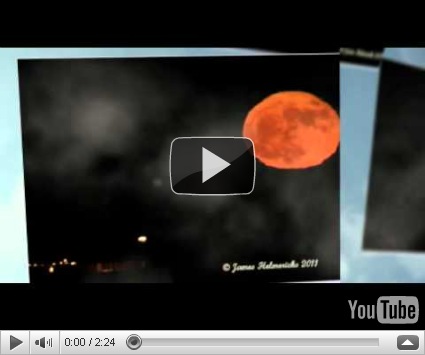
 

This video has a whole series of moon mirage pictures taken at the same time as the marshmallow shaped moon picture posted above.

Wednesday, September 29, 2010

Colville Lousewort's

We have four species of lousewort (Pedicularis) growing around our home here in the Colville Delta.  With the different species we get a blooming period from early June through late August, and even a few stragglers into September if it is a warm summer.  The habitat varies from dry polygon ridges to wet sedge meadows; all lousewort are edible though some have a tap root too small to be of much interest.

The genus name, Pedicularis,  means little louse. It was once thought that animals feeding on this plant would become infected with these pests. Wort comes from the old English word meaning flower, giving us lousewort.

The Wooly Lousewort (P. Kanei subsp. Kanei) is the first to appear in the spring, often starting to grow in early June when much of the ground is still covered with snow.  It isn’t uncommon to find the first ones of the season blooming in a small patch of tundra surrounded by snow, a bit of pink in a world of white. To protect itself from the freezing temperatures and cold winds it has developed a covering of dense wool, and before it starts to bloom, it looks so different it could be mistaken for a different plant.  This plant also has the largest tap root of the four and it is good to eat cooked or raw, a good source of starch, and the taste is similar to that of a sweet potato.  It grows 15-20cm/6-8 inches tall from a thick yellow taproot with rose colored corolla.

 WoollyLouswort2_2383

 Lousewort-Woolly-V_2354


WollyLousewort_1495


  Three views of the Woolly in different stages    from early inflorescence white and woolly and as a mature flower.


The next two  louseworts to bloom are the Capitate (P. capitata) and the Purple lousewort (P. sudetica).   The Capitate Lousewort is yellow and prefers dryer ground and can grow in large patches covering several meters in diameter.   The stem is single, growing from a thin rhizome, and the unbranched stem can have up to four flower heads, although one or two are more common. The corolla is yellowish or at times the upper lip can become rose-colored with age. Average height is around 15cm/6 inches.

Lousewort-Capitate_7112Lousewort-Capitate-V_7117 


  The photo on the left shows the rose coloring that the older flowers can acquire, while on the right is one that is all yellow.


The Purple Lousewort (P. sudetica subsp. albolabiata) likes moist to wet tundra and grows either  as a single flowering stem, or in clumps of ten or more flowering stalks from stout rootstock.  These  two plants tend to have a long growing season and overlap the start of the flowering of the fourth species that grows here.  The petals are multicolored,  having a pink corolla with a purple apex that has a white lip.  This species is also referred to as the Sudeten Lousewort.

 Lousewort-Purple_2812  Lousewort-Purple-V_2817


A nice Purple Lousewort  cluster and a close up of the flowering head.

The Whorled Lousewort (P. verticillata) has the most delicate blossoms of the four and you can have a single flowering stalk or many growing in a tight group from a branching taproot.   They like moist meadows and river banks and grow up to 7 inches or 18cm.  Petals are purple with a pink base.

Lousewort-Whorled-V_5396 Lousewort-Whorled_5377


A nice group of Whorled Louseworts on the left with a close up of the flower on the right.

All of our louseworts have eatable tap roots, but other than the Woolly, most are too small to make it worthwhile to collect.  Speaking of collecting, some species of voles collect lousewort tap roots and store them in small caches for the winter.  The vole caches I have found are usually about a cup in quantity.  Since these are such a good food source, the grizzly bear love to search out these vole treasures and feast on them.  I watched one bear work several willow thickets in the river bed, and after a couple hours had consumed a large quantity of stored roots.  I’m sure the voles weren’t too happy about this, but at least they didn’t get eaten on this day.

LaplandRosebay-0439 One last photo showing a yellow Capitate Lousewort blooming next to a Lapland Rosebay (Rhododendron lapponicum).

Wednesday, September 22, 2010

Fresh Snow

The seasons are changing again, a light snow is falling and covering the rust and red colors of the fall tundra.  The soft flakes are of a mixed size, but it isn’t coming down hard enough to completely cover the ground yet.  As I look out the kitchen window in the early dusk of the coming morning , I am treated to the sight of the cow and calf muskox sleeping in our Muskox-Snow_5333yard and partly covered in the falling snow.  They are not in a hurry to get up and start feeding, as both have gotten up, walked in a circle and then laid back down.  At times they were stretched out full length sleeping , while the more normal position has them resting with their head up, as to keep a watch on things in between naps. 

 Ready-to-Travel_5352

It is hard to grasp that this gentle snow fall with its big flakes is not a common sight for us during the winter.  Most of the time the snowflakes are well rounded and small by the time they reach the ground in our windy climate.  I’m sure that during some stretches of  winter we see the same snow several times, as the wind whips it back and forth and the drifts of winter deepen.


Pendent_Grass-sn_7308The lake has ice around the edges this morning and the red pendent grass (Arctophila fulva) is either weighted down with the fresh snow or frozen in the fresh ice, which doesn’t extend much past the grassy area.

SnowyPendentGrass_7310


The Willow Ptarmigan are glad to see a bit of snow as they are starting to stick out in the rusty colored tundra since they are almost all white now.  It makes them very nervous and take flight at the first sign of a falcon or snowy owl.  They like to swoop in and hide in and around the buildings where it is harder for a bird of prey to make a diving run to catch one. 

WIPT-flock_flight_5403       Large flock of Willow Ptarmigan taking flight.

LateSept-WIPT_5408

One afternoon several years ago I watched as a snowy owl and a flock of 30 willow ptarmigan played keep away.  The owl had the birds cornered at the base of  an old wire bird cage that was 10’ square and 8’ high that I wasn’t using anymore. The owl was perched up on top and when it moved from one side to the other the ptarmigan would quickly run to the other side staying right up against the pen.  This maneuver didn’t give the owl enough room to swoop down and grab one of the ptarmigan. This went on for about 45 minutes before the snowy owl decided it would have better luck some place else.

With the days of fall getting shorter, we now can enjoy the Aurora Borealis again as well as watch the constellations swirl overhead.  It looks like it will be a good winter for sky watching the as the sun has been putting out lots of solar activity that translates into good viewing conditions.

 Aurora Reflections_5139 Aurora Borealis reflecting in the lake.

Creative Commons License
Arctic Smoke Signals by James W. Helmericks is licensed under a Creative Commons Attribution-Noncommercial-No Derivative Works 3.0 United States License.