Wednesday, January 6, 2016

Green, Green, Skies

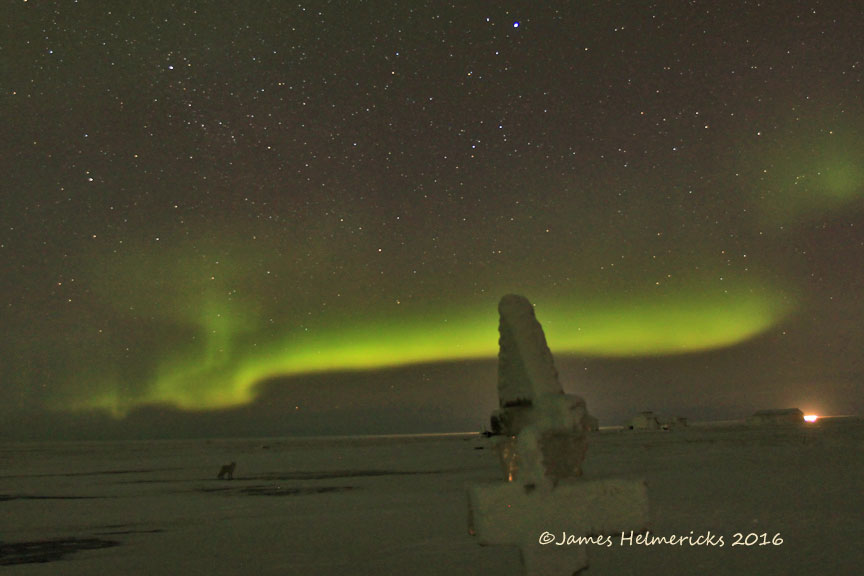
A warm spell with scattered clouds here at our homestead in the Colville River gave me a chance to view and photograph the northern lights in temperatures 30-40 degrees warmer than I usually have to contend with.  Even if the lights were not that active I wasn’t going to miss a chance to be out and not freeze my nose or cheeks on a cold camera.

Being outside when the temperature was only +20F/-29C was like watching the light show just after freeze up in late September not early January.  I made my first trip out to film just after midnight, and at that time the sky was covered with  various shades of green aurora. 

 
Shimming lights over the homestead
They were not especially active but at times there was just a hint of red on the edges of some of the curtain type displays.  All the big sheet type of aurora remained  green and covered so much of the sky the snow took on a green cast at times.  there was also a band of clouds to the east of me and it was glowing orange-red from all the oil field lights in that direction.  After about an hour the northern lights faded and so I took a coffee break and waited to see if they might come back.


In this photo most of the aurora is a sheet but there is also some descending curtains that have a very weak mix of red along their upper edges.


Here is a photo showing lots of green with the cloud cover reflecting orange from all the lights on the horizon.


Here we have a all green auroral corona with its rayed bands spreading out in all directions.


 A lovely green swirl pattern developed as the first active episode started to fade away. 


 I went back out two hours later and the lights were more on the horizon in narrow bands, the big sheet type had disappeared. 


I filmed a couple neat formations and when I got back in the house and looked at one of my shots there was a red fox off in the distance, I’m sure wondering what I was doing.


 Here is a photo of the fox that I managed to get just as I was getting  camera gear ready to go in the house.  The fox was running about looking for scrapes that my dogs may have left laying around. A special way to end a lovely night of  aurora watching.

Saturday, December 26, 2015

Christmas Full Moon 2015

Clearing skies gave me the opportunity to film the full moon this Christmas season, one that doesn’t come come around very often and the next one won’t be until 2034 . Our stretch of clear weather also brought our coldest weather of the season with the temperature at –32F/-26C Christmas morning.


On the 24th, the sky was covered with a thin overcast layer and the moon was showing a 22 degree halo for most of the morning. At other times the moon was visible through thicker clouds that didn’t have the necessary ice crystals for the formation of halos or arcs. Christmas Day broke bright and clear with visibility greater than 25 miles, just what I needed for my project I had in mind for this day. I wanted to film the setting full moon once it descended low enough to be effected by the inversion layer that creates mirages. In order to be able to do this I needed a very clear horizon to the north as that is where the moon would be setting today.

While waiting for the moon to move around to the north I filmed it with various objects around the homestead. There was nice contrast with the moon and some of the willow bushes covered with thick frost and a nice moon beam shimmering across our lake ice.


The final moment arrived around 11AM when I started my project which lasted until 12:25PM. With the temperature holding at –31F, I was glad that the wind had dropped from yesterday’s 14 mph wind and a wind chill of –54F. My camera battery had a full charge when I started, but with the cold it was blinking and about to shut the camera down when I took my last photo of the series #115.


Start of the series of photos as the moon starts showing the inversion causing mirage effect. This second photo also has a small green flash on top and what looks like a orange one on the bottom as refraction is causing colors to separate along the edges of the moon. Time 11:41 AM


Time 11:49 AM moon is being distorted more on the bottom as it gets closer to the horizon. Notice another capture of a green flash.


Time 11:54 AM another green flash can be seen and the moon has been pulled apart on the bottom.


Time 11:59 AM in this shot the two halves look almost like mirror images as the moon looks to be touching the horizon.


Time 12:03 PM Here the mirage has taken on an almost rectangle shape with a small anvil and green flash on top.


 Time 12:16 PM now just two thin strips as last of moon mirage is about to disappear. This is where my battery gave up and since there wasn’t much more to see I didn’t put in a fresh one. Also even with my fur parka and other heavy gear I was chilled and ready to snuggle up the warm wood stove for a spell.


It was fun watching the moon go from a round shape to one that was constantly shifting and becoming more flattened or elongated. To add to the thrill, I was also able to see and catch on film several green flashes. A green flash is caused by refraction causing color separation when the moon’s disk is close to the horizon.


As a side note, I was actually filming the moon below the horizon for the last 20minutes or so as atmospheric refraction causes a vertical shift of about half a degree. Since the moon’s angular diameter is also half a degree the moon is really below the horizon when the moon’s disk appears to touch the horizon.


Wednesday, May 14, 2014

Spring Birding

After a day of high winds and snow showers, the bright sunshine today  made one want to get out for a birding trip. It would most likely be the last one by snow machine since we are just starting  our break up period, and flowing water would stop land travel off our home island.

Even with the bright sun, it was a chilly day with a brisk wind out of the southwest and the temperature never got above +34F  while I was traveling about.  I  headed up river  from our home and checked out some of the islands that have a sand dune system. The winter wind move sand from the dunes and the snow in this area melts out sooner and creates feeding area for the returning geese sooner than the less sandy areas.   In one area next to a small frozen lake there were 50 greater white-fronted geese (Anser albifrons) feeding.  Most had already separated into pairs as they spread out over the tundra feeding in the wet areas.  

About 4 miles up river I started seeing well defined shore leads as the advancing first water of break up moved our way. 

flood waters_6627

View looking up river with the green bands of the shore leads on each side of the deep water channel.

Besides the white-fronted geese seen feeding who were local birds that would be nesting in a couple weeks, several flocks were seen moving west. There were also a few snow geese  mixed in with these white-fronts  heading farther to the west  to nest.

gwfg1_6632

         Greater White-fronted Geese

sngo1_6623

sngo2_6635

                                                    Snow Geese migrating westward.

I covered 14 miles in my travels and saw three new “first of the year”  birds on my travels. They were a pair of Hoary Redpolls feeding on grass seeds poking out of a snow patch, a flock of Pomarine  Jaegers (Stercorarius pomarinus) migrating east, and a pair of Tundra Swans traveling further to the west.

poja1_6630


       There were a few dark phase individuals in the flock of Pomarine’s , but the majority of them were the light phase with their white bellies.


Most of the Willow Ptarmigan (Lagopus  lagopus) I saw were males on territory and the females were near by I’m sure hiding in the patch work of snow and bare tundra.  I did find one pair and I was able to get a photo of her. She still has a ways to go to get changed into her summer plumage.

wipt-F_6636


    Female willow ptarmigan changing into her summer plumage.


On the way back home I stopped at a nice dry bluff to see what might be starting to turn green. Grasses are not showing any new growth yet, but I found several fresh moth cocoons and puffball mushrooms from last fall that showed the hole blown out in the top when dispersing  their spores before freeze up.

cocoon_6641

puffBall_6646

From this location I took a photo back towards the homestead, which was 3.5 miles away to show how much snow still covered the tundra.  Overall it was a wonderful trip and besides the birds, I also saw 1 red fox and 15 arctic ground squirrels.

Home14May_6647

Tuesday, June 18, 2013

Halos, Fog Bows, and Light Pillars.

The long winters provide one with plenty of opportunities to observe objects created by various types of ice crystals in the atmosphere.  Some close to the ground, others high above.   I will cover some of the more common ice halos I have seen and filmed, but if you are interested in more detail on these and the much rarer ones I suggest  checking out some of the excellent web sites that  cover atmospheric optics.

Fog Bows:

Fog bows are also called white bows, mist bows, or cloud bows and are usually formed when the fog layer is dissipating and the sun is starting to shine through.  Rain bow colors and size  are affected by the size of the drops in which they form.   Rain drops that are 0.1mm or less are almost colorless and are found in fog and clouds,  and while fog bows are smaller in diameter than rain bows they tend to be wider.  You can also have a lunar fog bow, but they are much rarer.   The very small October_Bow_7368water droplets do not freeze at zero Celsius  and so unlike a rainbow, you can have fog bows forming in temperatures below freezing.


FogBow_Aurora-BigDipper


Photo on the left is a sunlight fog bow in early October arcing over our Homestead.

The second photo on the right shows a lunar fog bow with a hint of aurora borealis in the night sky.


Sun & Light Pillars:IMG_5644

Sun Pillars are created by reflection of sunlight through  ice plate crystals  as they fall towards the Ruby-Antlers-Sunset_0742ground with their bases horizontal.  This acts like a microscopic mirror reflecting the sun's image up or down depending on which side of the sun the crystals are.   Light Pillars are formed from the same ice crystals as those creating a sun pillar, but from an artificial light source on the ground.


Both photos show the setting sun with a tall light beam shinning above it.  The picture on the right also has a faint tangent arc which is covered in more detail below.

Frost_LightPillar-2-6_6095


ColoredLightbeams_1360

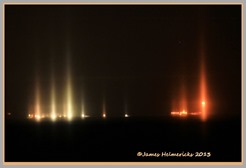
These Two photos show the different colors that develop from an  artificial light source. 


Atmospheric Halos:

Ice Halos.........ice halos are formed by tiny ice crystals that create rings and different arcs depending on the hexagonal shape of the crystal, which can be narrow columns or thin plates.  Both shapes refract and reflect the sun or moon light creating rings and at times various arcs around them.

The most common ice halo is the 22 degree one, but if the cloud cover isn't complete or gets too thick,  you may only see part of the halo.   If conditions are right for a bright halo it will have a red tinge to the inner part of the circle facing the sun.  The halo is caused by refraction of sun or moonlight as it passes through the small hexagonal ice crystals, and will be fainter in the moon light.

Moon-Jupiter-Halo


This is a photo of a 22 degree lunar halo, also visible is a lower and upper tangent arc.


Halo-Clouds_7277


A 22 degree halo developed as the sun was about to set in the south in early winter.


Some of the rarer arcs seen in conjunction with a halo are tangent arcs, parhelia, parhelic circle, and the circumzenithal arc.

Parhelia.....also called sun dogs are bright patches seen near the edge of a 22 degree halo.  They are caused by refraction of hexagonal crystals and can be seen with out a halo or just one bright patch may be visible and is called a parhelion.  If the source of light is from the moon they are called parselena or moon dogs.
Parhelic Circle........at times one may see a colorless band parallel to the horizon and level with the sun, this is called the parhelic circle.  In rare instances it can form a complete circle opposite to the direction of the sun.
Tangent Arc ... When the sun is low a colored arc can form at the top of the halo, looking like a bird in silhouette, or short spikes.  They can also form at the bottom of the halo as the sun increases in elevation, and they are called either a upper or lower tangent arc.
Circumzenithal Arc .. the circumzenithal arc is formed from the same type of crystal as the parhelia, but tend to be brighter with more color than parhelia.  In fact they can rival a rainbow for color and brightness, but they differ in that these arcs are on the same side as the sun with the red color closest to the sun with the curve up not down as in a bow.

 Midnight Sundogs_3423


Setting sun with parhelia/sun dogs on the edge of the 22 degree halo.


BlueMoonHalo_2009


This photo shows the white parhelic circle passing through the sun and extending out past the halo. There also weak sun dogs at the edge of the halo.


Tangent Arc_7460


Here is a good view of a upper tangent arc.


circumzenithal-arc60


Here we have the bright circumzenithal arc, which is seen above the 22 degree halo and upper tangent if visible.

Saturday, June 15, 2013

Spring Flooding 2013


Our winter wasn’t as cold as last years, but we had more snow which set us up for serious flooding if the right conditions were met.  Winter did not want to leave and we were still  having very cold temperatures into the month of May. Usually we experience a few days of melting at the end of April or beginning  of May, not this year.  On the first of May the night time temperature dropped to –20F/ –29C  and  it wasn’t until after the middle of May before we had temperatures getting above freezing.  On the 1st of May I took the monthly ice thickness in the Colville River by our house and even with 17 inches/43cm of snow on top of the ice it was still  68 inches/172.7cm thick.

                                                     Standing on snow machine to start the drilling operation to get through the   thick ice.

The early arriving Greater White-fronted Geese had a rough two weeks before there was much melting providing water and bare ground for feeding.  Our Snow Buntings were three weeks later  than the yearly average with the first male showing up at the feeder on May 6th.

SpringSNBU13_5272


   Male Snow Buntings waiting out a  breezy snow squall.


Brant-SNGO_1297


A group of Black Brant with a pair of Snow Geese feeding in a small patch of melted out tundra before breakup.


When the weather finally turned warm at the end of May it stayed warm, not even freezing at night so the spring runoff  was rapid and this led to our second worst flood in the past two decades.  We live on a island in the Colville Delta and over 85%   of the island was covered in water.  Several of the waterfowl nesting areas were flooded with several feet of water and many of the early nesters lost their nests. 

brant


      Brant flying over a white landscape.


Flood-eidersRvr_5320


River starting to flood its banks with a small group of King eiders resting on a small pan of river ice.


BrantFlooding_5351


   Local breeding Brant flocking up on some of the last high ground during this years flood.


June 5 Flood


View showing water around some of the buildings and flooded runway in the center of the photo.


King Eiders Flood waters


    A flock of King Eiders in the edge of the flooded lake by our house.


Fortunately most were just starting and were able to continue once the water levels receded, although many of the clutch were smaller than in a normal  year. 

Black Brant and Nest

         A female Brant starting her second attempt to lay eggs this spring.  She now has two eggs and is starting to add down from her breast to help insulate the eggs  while incubating.  She also covers the eggs with the down when she leaves the nest to go bath and feed for short periods several times a day.  The down will keep the eggs warm for several hours.

Home-Aug2010_3354


I will end with a photo showing our island and lake when it is dry and green.

Creative Commons License
Arctic Smoke Signals by James W. Helmericks is licensed under a Creative Commons Attribution-Noncommercial-No Derivative Works 3.0 United States License.