Showing posts with label red fox. Show all posts

Wednesday, January 6, 2016

Green, Green, Skies

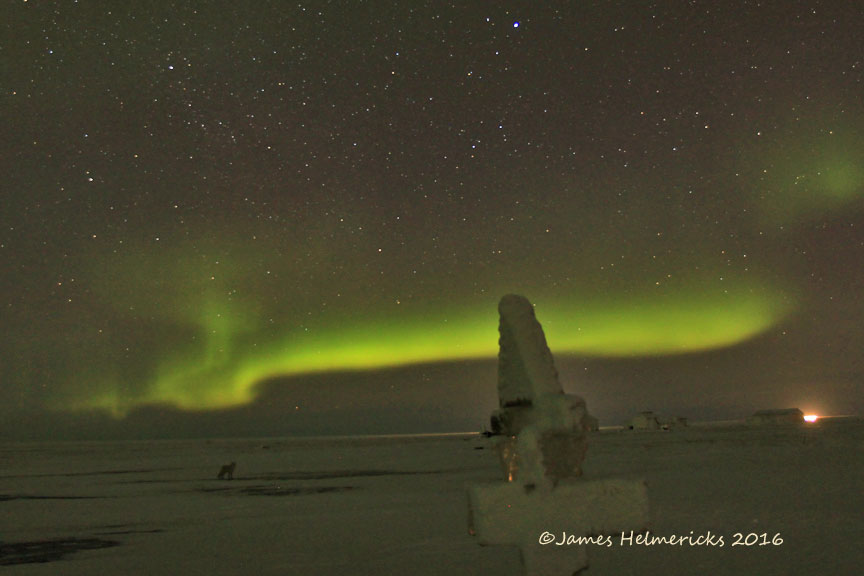
A warm spell with scattered clouds here at our homestead in the Colville River gave me a chance to view and photograph the northern lights in temperatures 30-40 degrees warmer than I usually have to contend with.  Even if the lights were not that active I wasn’t going to miss a chance to be out and not freeze my nose or cheeks on a cold camera.

Being outside when the temperature was only +20F/-29C was like watching the light show just after freeze up in late September not early January.  I made my first trip out to film just after midnight, and at that time the sky was covered with  various shades of green aurora. 

 
Shimming lights over the homestead
They were not especially active but at times there was just a hint of red on the edges of some of the curtain type displays.  All the big sheet type of aurora remained  green and covered so much of the sky the snow took on a green cast at times.  there was also a band of clouds to the east of me and it was glowing orange-red from all the oil field lights in that direction.  After about an hour the northern lights faded and so I took a coffee break and waited to see if they might come back.


In this photo most of the aurora is a sheet but there is also some descending curtains that have a very weak mix of red along their upper edges.


Here is a photo showing lots of green with the cloud cover reflecting orange from all the lights on the horizon.


Here we have a all green auroral corona with its rayed bands spreading out in all directions.


 A lovely green swirl pattern developed as the first active episode started to fade away. 


 I went back out two hours later and the lights were more on the horizon in narrow bands, the big sheet type had disappeared. 


I filmed a couple neat formations and when I got back in the house and looked at one of my shots there was a red fox off in the distance, I’m sure wondering what I was doing.


 Here is a photo of the fox that I managed to get just as I was getting  camera gear ready to go in the house.  The fox was running about looking for scrapes that my dogs may have left laying around. A special way to end a lovely night of  aurora watching.

Monday, April 12, 2010

Warm Sunny Day

What a difference a day makes as we went from -25F to a balmy +26F in about twenty-four hours.  The weather had been colder than normal for this time of year, so it was an extra special day to be so warm with bright sunshine.  With the added reflection off the snow, it was so bright out that it made me squint even with sunglasses on.  It also has been a snowy winter and we have a deeper snow cover than we would on average.  Even with all the wind storms to blow snow away, most of the tundra lies buried and this has likely contributed to the fact that we have very little bird life around the house yet. 
I had hoped to see a few willow ptarmigan around the local area by now, but with the deeper snow cover they seem to be late moving this far north.  They are most likely still further up-river where the willows grow tall enough to reach above the snow and provide willow buds and left-over leaves on which the ptarmigan can feed.  Down here by the house our willows are only inches tall and one variety, the snow willow, grows flat along the ground.  For this reason, it doesn’t take much snow cover to make feeding hard for the ptarmigan.
I decided to take advantage of the nice day and take a snow machine trip, going up river a few miles to  see if I could find some  ptarmigan to photograph.  In 38km of travel, the only bird I saw was a raven about 2km from home.   After about an hour of wandering about 14km around the delta and seeing only a snowy landscape, I reached the south end of a large island that we can Ptarmigan Island.  It is good habitat for ptarmigan most seasons but today there wasn’t even a track or any sign that any birds had been feeding in the area in recent times. 
No birds here but I did find one lone cow caribou in one of the vegetated sand dune areas.  She was lying down chewing her cud when I first spotted her, and she finally got up as I neared her location. 

Caribou-sleep_7234

She let me get within 100 meters, then started moving off, with me following along for a short spell, taking pictures as I went. 


          Resting Cow Caribou


Caribou-Apr_7244

When I stopped following her, she went on for another 400 meters or so and went back to feeding.


Caribou Watching Me Take Its Picture.

As I turned away from the caribou, I spotted a red fox watching me on down the island a ways.  I drove towards it to see if I could get close enough for pictures. 

RedFox-April_7265

It didn’t seem too frightened and let me get with 120 meters, and when I stopped the snow machine, it turned back and worked closer to check me out. 

   Red Fox on a Bright Sunny Day.

There were signs that a seismic company had been doing work earlier in the winter in this area, and some of the crew probably had been leaving food out for it. Thus she worked downwind to see if there was any food smells about. 

RFox-face1_7267


IRFox-face2_7292


The Pair of Red Foxes, Female on Left, Male on Right.

After about 10 minutes she decided to continue on down the ridge, going in the general direction of the feeding caribou.  I continued on my way in the opposite direction and as I drove over the top of large dune there was another fox out in a flat area.  I headed over in its direction and stopped about 75 meters away.  It was following along one of the old track vehicle trails, sniffing here and there, perhaps getting a few old food smells.  

RFox-squinting_7294Sunglasses Needed!  Both Foxes and the Caribou Kept  Squinting in the Bright Light.

As it turns out, it was the male and he came within 20 meters of me, checking to see if I might have something of interest.  After taking several pictures we heard the female barking and he headed off in her direction.  I followed along hoping to get pictures of them together.  I did get a few long shots of them together but they kept moving rapidly along the ridge and finally separated, so I let them go their way and I continued on my travels to see what else I might find.

RFoxs-April_7304

They were the last game seen on my travels this day, although I did see a lot of pretty country and it was great to just be outdoors enjoying such a bright day. 

I stopped on top of a Pingo* to survey the surrounding area, looking for game. All I saw there was a set of fresh white fox tracks, but never saw the fox.

*A pingo is a mound of earth-covered ice found in the Arctic and subarctic that can reach up to 70 metres (230 ft) in height and can only form in a permafrost environment. They are essentially formed by ground ice which develops during the winter months as temperatures fall and cause the ground to push up.


CaribouFace_7245

A Close-up of the Caribou’s Face Showing Her Reacting to the Bright Sunshine.

Saturday, March 6, 2010

Snowmachine Trip

February was on the warm side for us, and that in turn led to many overcast/whiteout or stormy days.  On one of the better weather days,while on the cold side, I took advantage of the clear skies and sunshine for a trip.

It was a great feeling to be out in the sunshine after the dark days of deep winter. I traveled around 30 Km, enjoying the day, looking for caribou and foxes, which are the main large animals we have here this time of year.  I saw several small groups of caribou, from a single animal to a group of 7 cows, for a total of 30 head.  The sun was still low when I took a few pictures of one of the groups, and the snow drifts reflected an orange-red glow to the scene. 

Winter-Caribou-Group4_6505

Group of Caribou cows feeding with pale sunlight reflecting on the snow drifts.

WinterCaribou1_6504

           Caribou cow close-up.

Besides the caribou, I saw two white foxes and one very dark red fox.  The white foxes were too far away for pictures but I watched them through the binoculars as they went about their day hunting for lemming nests under the snow.  As an adaption to winters in permafrost country, lemmings and voles make grass nests above ground during the winter months.  This in turn provides a winter food source for the foxes by having the rodents where they can catch them more readily.  Also, white foxes that are not attached to a den or raising pups, move around in the summer looking for abundant food sources like water fowl nesting colonies.  When they find a area of abundant food, like waterfowl nests, they cache most of the eggs for later.  Most of the time it isn’t the fox that made the cache that finds the food, as that fox could be hundreds of miles away by winter time.   Over the millennium this has developed into a survival technique that helps the foxes make it through the lean winter and early spring months when food is hard to locate. 

When I saw the red fox, it was moving somewhat in my direction, so I drove over to a mound that was more in line with the fox's line of travel, and waited to see if it would come close enough for pictures.  With the cold temperatures (-25F/-32C), I kept my camera inside my fur parka that I was wearing.  That  way I don’t have to worry about it being out too long and having the battery frozen up when I'm ready to take a picture.  When the fox was about 200 meters from me, it realized I wasn’t just a dark spot on the mound and changed direction, moving away.  I started up the snowmachine and started following it, angling along its direction of travel.  It let me get close enough for a few pictures before it picked up speed and loped off.  

Winter_Fox1_6499

A dark red fox checking me out.

I then headed away from the fox, and after it watched me and was satisfied that I was indeed leaving, it turned and continued in the direction it had been going.  I’m sure it had a den off in that direction and will check it out later in the spring.  While I was looking for more caribou to film, I found what the red fox had been eating on, a dead yearling caribou.  It has been a hard winter for the caribou in this area as we have had two periods of melting and/or freezing rain.  This makes it harder for the caribou to dig through even a small amount of snow, and combined with all the blizzards and some cold temperatures, many of the yearlings have perished.

From there I worked my way home as the sun was starting to set and picture taking conditions were about over.

Monday, April 20, 2009

No New Birds, Just a Lovely Red Fox

Well it turns out that the snow bunting that was sighted in the evening of the 18th was just passing through. So we still don’t have any birds feeding at the feeder yet.

We did have a lovely visitor this afternoon that stayed around for about a half hour looking for fish scrapes that our dog Toby had left about. We have had both the red fox and a couple white foxes around but lately they have been around only at night, and just their tracks visible in the morning light to let one know they were here .AF_Tracks_2945RF_Face1_0414

Today the male red fox came by as we were getting ready for lunch and we watched him out the kitchen window. The snow drifts are so deep around the house that he came right up and looked in the window! I was able to get a picture of him looking at us looking at him. RedFox3sm_0435He then check other area in the yard then headed back up river towards the area that has nice sand dunes where there has been a den for many years.

It was bright sunshine for most of the day and our warmest so far this month getting up to +9F. The wind has also changed direction and is starting to blow from the south so maybe that combined with warmer temperatures will bring the snow buntings. It has been a cold spring and looking back to 2004 we had seven snow buntings here on this date.

Take Care

Jim

Creative Commons License
Arctic Smoke Signals by James W. Helmericks is licensed under a Creative Commons Attribution-Noncommercial-No Derivative Works 3.0 United States License.